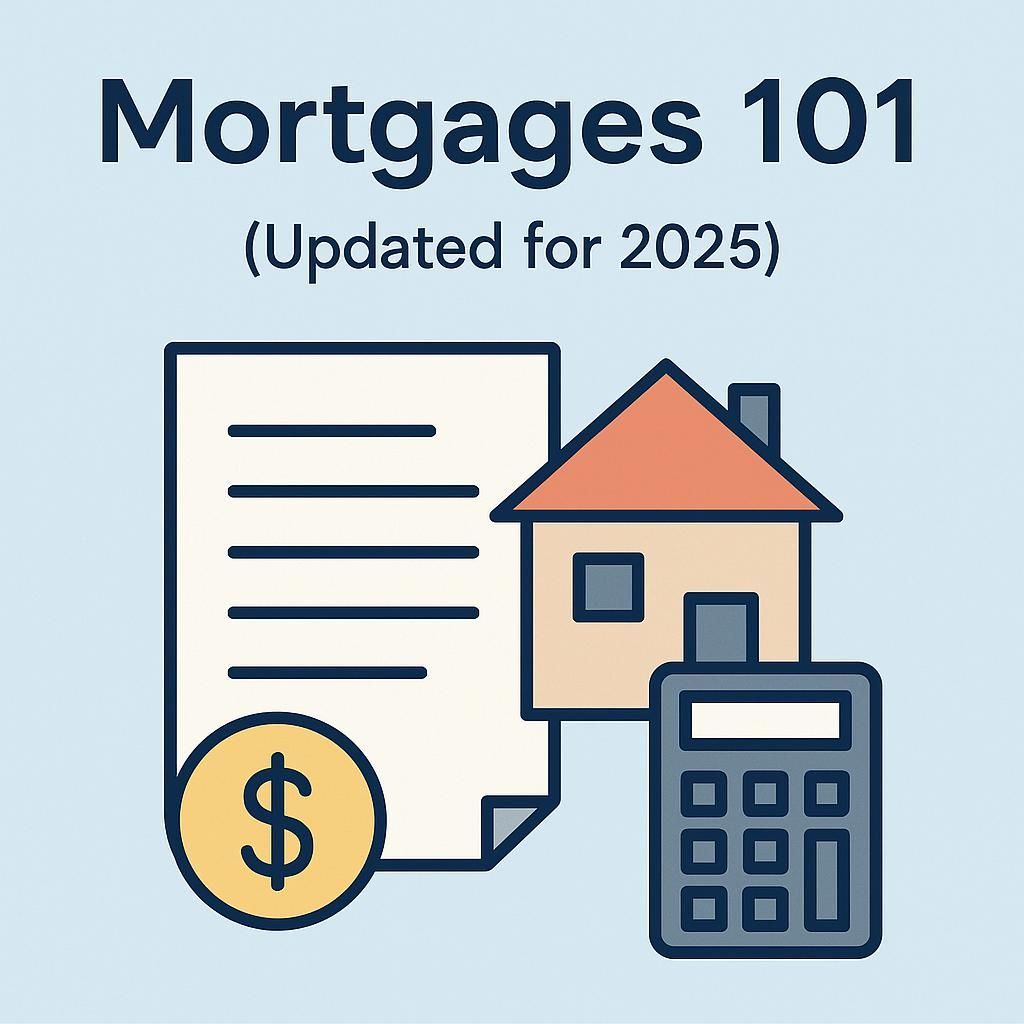
Mortgages 101 – What you need to Know about Mortgages (Updated for 2025)
Buying your first home is exciting—and rather nerve-wracking! With so many mortgage options, the process can feel like a maze. My job is to make mortgages simple.
Below is your
step-by-step guide to how mortgages work, along with the
key 2025 updates every homebuyer should know.
What is a Mortgage?
A mortgage is a loan secured by your home. If payments stop, the lender can take possession and sell the property to recover what’s owed.
Your payments cover two things:
- Principal – the amount you borrowed.
- Interest – the cost of borrowing.
The Building Blocks of a Mortgage
- Down Payment – The cash you put in upfront.
- In Canada, you can buy with less than 20% down if you purchase Mortgage Default Insurance.
- Minimum: 5% of the first $500,000 and 10% of the portion above $500,000 up to $1,499,999.
- Amortization – How long you take to pay the loan off (25 or 30 years are most common).
- Term – How long your rate/contract lasts before you renew (usually 1–5 years).
- Rate Type:
- Fixed: your rate/payment stays the same.
- Variable/Adjustable: tied to your lender’s prime rate, so your costs may change.
👉 New to mortgages?
Check out my
20 Terms Home Buyers Need to Know.
Getting Approved
Lenders look at: your income, debts, credit history, down payment, and the property itself.
You also need to pass the mortgage stress test—qualifying at either your contract rate + 2% or 5.25% (whichever is higher).
Want to strengthen your credit before buying?
What’s New (Big Changes that Matter)
- 30-Year Insured Amortizations – Now available in select cases (first-time buyers & new builds).
- Insured Mortgage Cap Raised to $1.5M – Up from the old $1M.
- RRSP Home Buyers’ Plan (HBP) Limit Increased – You can now withdraw up to $60,000 per person.
- First Home Savings Account (FHSA) – Tax-deductible in, tax-free out.
- Read my guide here First Home Savings Account (FHSA) - 5 Things You Need to Know
- BC Property Transfer Tax (PTT) Relief Expanded – First-time buyers can now qualify on homes up to $835,000 (partial up to $860,000). There’s also a separate new build home exemption with higher thresholds.
Mortgage Default Insurance
If you have less than 20% down, default insurance allows you to buy. Premiums are added to your mortgage and vary by down payment amount.
🔗 Learn more in my updated post:
Everything You Need to Know about Mortgage Default Insurance (2025)
Fixed or Variable – How to Choose?
- Fixed: Payment certainty and peace of mind.
- Variable/Adjustable: Potential savings when rates drop, but higher risk.
👉 Deep dive here:
Mortgages Made Simple – Fixed vs. Variable Rates.
Why Strategy Beats “Lowest Rate”
The lowest rate isn’t always the best mortgage. A cheap rate can come with big penalties, poor prepayment terms, or restrictions that don’t fit your future plans.
I help clients evaluate based on
4 key priorities:
- Lowest total cost
- Lowest payment
- Maximum flexibility
- Lowest risk
Next Steps
- Try my Mortgage Planner Tool – run your own home buying scenarios.
- Book a 15-minute Zoom chat with me—I’ll help you find the mortgage that works for YOU (not your bank).
Bottom Line: Mortgages are complicated, but they don’t have to be. With the right expert in your corner, you’ll save money, avoid costly mistakes, and buy your first home with confidence.
Need help navigating your home buying & mortgage financing options? I’d be happy to guide you through what’s possible.
Kelly Hudson
Mortgage Broker
604-312-5009
Kelly@KellyHudsonMortgages.com
www.KellyHudsonMortgages.com